
ADA Signs That Feel Like Part of the Architecture
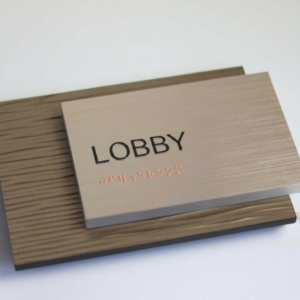
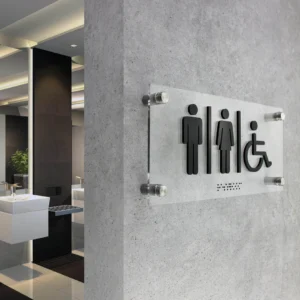
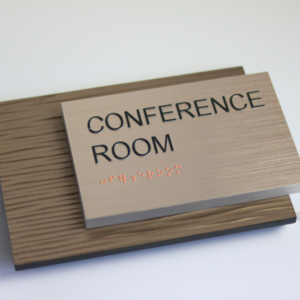
H.M. Witt makes wood accent ADA signs with real wood veneer faces, raised tactile characters, and Grade 2 Braille, so room and restroom identification feels like a continuation of the building’s doors and millwork rather than a compliance afterthought. Every sign meets the 2010 ADA Standards for Accessible Design in full, with a matte or satin sealant, high-contrast raised copy, and proper Braille placement, while carrying the warmth and grain of natural wood.
The process is straightforward. Send us a finish sample, a stain reference, or a photo of your millwork, and we match the veneer and confirm everything on a digital proof before fabrication begins. Once you approve the proof, we build the signs and ship them nationwide. Browse the options below, or request a quote to get started.
Request a Wood Sample Match
Browse Veneer-Faced Room and Restroom Signs

What Makes a Veneer-Faced Sign Worth Specifying
Plastic and metal signs do the job, but they announce themselves as separate objects. A sign whose face carries real wood grain, matched to the surrounding trim, reads as something the architect intended rather than something the contractor ordered at the last minute. That sense of a finished, considered space matters most in environments where guests, residents, or patients form lasting impressions from the moment they step into a corridor.
Hospitality properties, law offices, corporate headquarters, senior living communities, healthcare facilities, universities, and houses of worship are the settings where this choice comes up most often. These are spaces where the door hardware, the millwork profiles, and the wall finishes are all specified together, and the room identification ought to be held to the same standard.
Matching existing veneers and stains is where the work really happens. Whether your doors are walnut, maple, cherry, oak, or another species entirely, we select a veneer that aligns with the grain pattern and tone, then dial in the stain on the digital proof. The result sits beside a door as though it was drawn in the same set of elevations. All available species and stain options are confirmed at the proof stage.
Each sign is built with a sealed veneer face bonded to a rigid substrate. Raised characters and Braille are applied in a contrasting color, giving the tactile elements the visual separation required by code while keeping the overall aesthetic quiet and architectural. The fabrication process is precise, the same kind of careful work that goes into photopolymer and layered-acrylic signs, applied here to a natural material that rewards close inspection.
The compliance requirements don’t change because the material does. Characters must contrast with the background, the sealant must produce a non-glare surface, and the Braille must conform to Grade 2 standards and proper dome dimensions. Choosing the character color means reading it against both the grain pattern and the specific tone of the stain, which is why the digital proof is essential before anything goes into production.
Sealed veneer faces stand up well to the daily reality of a busy corridor. The finish resists fingerprints, wipes clean with standard commercial cleaning products, and holds its color without the yellowing or surface degradation that affects some synthetic materials over time. Signs installed in high-traffic hallways near restrooms or stairwells are exposed to humidity and contact every day, and the construction accounts for that.
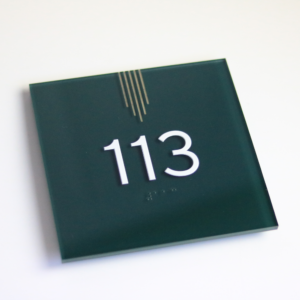
A single sign program rarely tells the whole story of a space. Pairing veneer-faced room identification with matching lobby directories, wayfinding panels, and suite number signs creates a coordinated visual system that carries the same material language from the entry through every floor. For projects where the budget supports it, combining real wood faces with brushed metal accents or inlay borders brings additional depth without compromising the clean, code-correct finish the signs require.
Frequently Asked Questions
What wood species and stains can you match?
Common requests include walnut, maple, cherry, and oak, but we work with a range of species and veneer cuts beyond those examples. All available options and stain confirmations happen at the digital proof stage, so you see the actual face material and finish before we fabricate anything.
Is a sign with a real wood face still ADA compliant?
Yes. Compliance depends on finish, contrast, character dimensions, and Braille placement, not on the face material itself. We apply a matte or satin sealant to meet the non-glare requirement, select the raised character color to achieve the required contrast against the specific grain and tone of your veneer, and build all Braille to Grade 2 standards. The result meets the 2010 ADA Standards for Accessible Design in full.
How do these signs hold up in high-traffic areas?
The veneer face is sealed and bonded to a rigid substrate, producing a surface that wipes clean with standard commercial cleaners and resists everyday contact. The sealing process also protects against the humidity common near restrooms and stairwells. The finish is designed for the same corridors where any commercial room sign would be installed.
Can you match our existing doors or millwork?
That is exactly what the matching process is built around. Send us a finish sample, a stain chip, a veneer spec, or a clear photo of the millwork or door faces, and we select the closest veneer and stain combination. Everything is confirmed on a digital proof before production begins, so you are approving a representation of the actual material, not a guess.
Can wood-faced signs be part of a larger building signage program?
Absolutely. Many projects combine veneer-faced room identification with matching directories, floor number signs, and wayfinding panels so the material language carries throughout the building. We handle full-program fabrication, and the same proof and approval process applies across every sign type in the package.
Do I need to know the ADA mounting requirements before ordering?
Not necessarily. The standard calls for permanent room identification signs to be mounted on the latch side of the door, with the centerline between 48 and 60 inches from the finished floor. We can walk you through the placement requirements during the quoting process, and our team flags anything that needs attention before the signs ship.
Built by a Team That Knows Compliance and Craft
H.M. Witt has spent years fabricating ADA-compliant signage for architects, interior designers, general contractors, facility managers, and property owners across the country. We understand that getting the code details right is non-negotiable, and we bring the same precision to material matching and finish quality. Whether you are specifying a single-floor renovation or a full building program, our team works with you from sample submission through proof approval to final shipment. Call us at 773-250-5000 to discuss your project.